
 By Luiz DeFaria, Owner of DeFaria Construction · BBB Accredited A+ · Updated October 2026
Basement finishing cost is the question every homeowner asks first, and the one most websites answer worst. A national calculator says $25 per square foot. A neighbor says they spent $90,000. Both can be true, because a basement is the one room where most of the budget is decided by things you cannot see yet: water, height, the foundation and where the drain sits.
This guide uses the typical 2026 ranges we see in Essex and Middlesex County, from Lynn and the North Shore out to the Merrimack Valley and the towns west of Route 128. It covers the cost per square foot, the cost by type of project, a line-by-line budget, and the items that quietly double a basement estimate. Use the headings to jump to the part that matches your basement.

How much does it cost to finish a basement in Massachusetts?
For most basements we scope in 2026, the honest range is about $35 to $90 per square foot. For a typical 700 to 900 square foot basement in a single-family home, that works out to roughly $30,000 to $75,000.
- Basic finish: about $35 to $55 per square foot. One open room, rigid foam insulation, framing, drywall, a simple ceiling, lighting, outlets and vinyl plank flooring. The basement is already dry and has decent height.
- Mid-range finish: about $55 to $90 per square foot. Two or three spaces, such as a family room and an office, a half bath or a small wet bar, better lighting, built-in storage and more trim.
- High-end or suite: $90 per square foot and up. A bedroom with an egress window, a full bathroom, a kitchenette or bar, custom carpentry and premium finishes.
These are typical ranges, not a quote. Labor and permitting around greater Boston run well above the national averages online, so a "$20,000 basement" from a national website rarely survives a local bid. The real number depends on what your basement needs before the finish work starts.
Basement finishing cost per square foot
Price per square foot is useful as a sanity check, but it hides the fixed costs every basement carries no matter its size: the permit, the electrical work back to the panel, the stairway, moisture control and the cleanup. That is why small basements often cost more per square foot than large ones.
- A 400 square foot basement might land at $60 to $110 per square foot, because the fixed items are spread over fewer feet.
- A 900 square foot basement with the same finish level often lands at $40 to $80 per square foot.
- A bathroom adds a big fixed cost of its own, so a basement with a bath almost always moves into the upper half of the range.
When someone asks about the price to finish a basement, the most useful answer is not a single number per foot. It is the cost of the scope you actually want, built on the basement you actually have.
Basement finishing cost by project type
Most projects fall into one of a few patterns. The table below shows the typical 2026 ranges for a 700 to 900 square foot basement in our area.
| Project type | Typical 2026 range | What usually drives it up |
|---|---|---|
| Open family room or office | $25,000 to $45,000 | Size, ceiling type, flooring |
| Family room plus half bath | $40,000 to $65,000 | Plumbing below the floor, ejector pump |
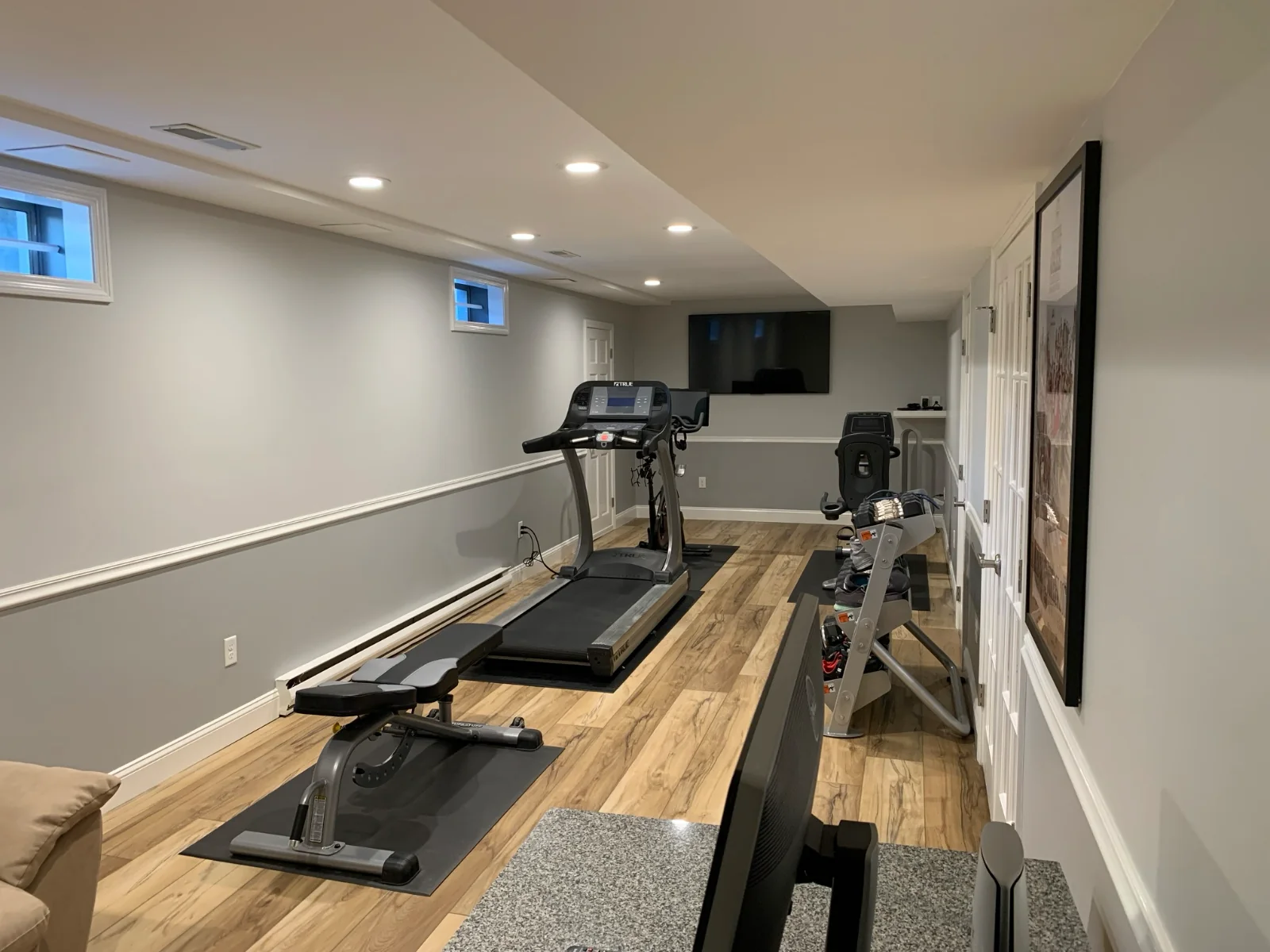
| Home gym or playroom | $25,000 to $40,000 | Rubber or vinyl flooring, extra outlets |
| Suite with bedroom and full bath | $55,000 to $90,000 | Egress window, full bath, more walls |
| In-law apartment with kitchenette | $75,000 to $120,000+ | Kitchenette, separate entrance, code items |
| Remodel of an old finished basement | $30,000 to $70,000 | Demolition, hidden moisture, mold cleanup |
If your project sits between two rows, the deciding factors are almost always the bathroom and the water. A dry basement without plumbing stays near the low end. A damp basement with a new bathroom moves toward the high end.
Where the money goes: a line-by-line budget
Here is how a typical mid-range basement of about 800 square feet breaks down. Your numbers will differ, but the proportions are a good guide when you compare estimates.
| Line item | Typical share | Example on a $55,000 project |
|---|---|---|
| Moisture control and prep | 5% to 15% | $3,000 to $8,000 |
| Framing, insulation and fire blocking | 15% to 20% | $8,000 to $11,000 |
| Electrical and lighting | 10% to 15% | $5,500 to $8,000 |
| Heating or cooling | 5% to 10% | $3,000 to $5,500 |
| Drywall, ceilings and finishing | 15% to 20% | $8,000 to $11,000 |
| Flooring | 8% to 12% | $4,500 to $6,500 |
| Doors, trim, built-ins and paint | 12% to 18% | $6,500 to $10,000 |
| Permits, cleanup and project management | 5% to 8% | $2,750 to $4,400 |
Notice what is not on this list: a bathroom. If you add one, treat it as its own budget on top of these lines.
Moisture and waterproofing: the cost nobody should skip
Water is the reason most finished basements fail. Before anyone frames a wall, a good contractor looks at how water reaches the foundation and what the basement does after a heavy rain or a spring thaw.
- Gutters, downspouts and grading: often a few hundred to a few thousand dollars, and the cheapest fix there is.
- Sealing cracks and penetrations: usually $500 to $2,500.
- A sump pump with a battery backup: commonly $2,000 to $4,500 installed.
- Interior perimeter drainage: often $5,000 to $15,000, depending on the length of wall and the floor.
- A dehumidifier sized for the finished space: $1,500 to $3,000 installed.
Older North Shore homes often sit on fieldstone or block foundations that let moisture through by design. Those basements can still be finished well, but they need the right wall assembly, and sometimes drainage, first. If a contractor wants to frame over a damp wall without addressing it, that low price will cost you later.
We also recommend a radon test before a basement becomes living space. Many New England homes benefit from a mitigation system, which typically costs about $1,200 to $2,500 and is easiest to add while the space is still open.
Insulation and framing costs
A basement only feels like part of the house if the walls are insulated the right way. Fiberglass batts pressed against cold concrete trap moisture, so the standard approach is rigid foam board against the foundation, sealed at the seams, with framing built inside it.
The Massachusetts energy code for our climate zone calls for basement walls insulated to roughly R-15 of continuous insulation or R-19 in the wall cavity. Foam must be covered by a code-approved thermal barrier, usually half-inch drywall. Expect foam and framing to run about $6 to $12 per square foot of wall, including the rim joist, which is one of the leakiest spots in older homes and should always be sealed and insulated.
You can read more about how we handle it on our insulation and drywall contractors page.
Egress window cost in Massachusetts
Any basement bedroom needs an emergency escape opening. Under the building code Massachusetts uses, that means a window with at least 5.7 square feet of clear opening, at least 20 inches wide and 24 inches high, with the sill no more than 44 inches above the floor, and a window well large enough to climb out of.
Cutting a foundation wall, installing a code-size window, building the well and draining it usually costs about $4,000 to $9,000 per window in our area. Ledge, a stone foundation or a tight lot push it up. A family room, gym or office without a sleeping room usually does not need one, but if you might ever use the space as a bedroom, it is far cheaper to plan the egress now.
How much does a basement bathroom add?
A bathroom turns a basement into a real suite, and it is the single biggest cost decision in the project. A new basement bathroom typically adds about $25,000 to $55,000 on its own.
- If the main drain sits below the new fixtures, the toilet and shower can drain by gravity, which keeps cost down.
- If it does not, a sewage ejector pump or an up-flush system lifts the waste, which adds roughly $3,000 to $7,000 but avoids breaking up much of the slab.
- A half bath with just a toilet and sink usually lands at the low end; a full bath with a tiled shower lands at the high end.
Every basement bath needs ventilation to the outside, waterproofing at the shower and a licensed plumber with a plumbing permit. Our bathroom remodel cost guide goes deeper on fixture and tile choices.
Heating and cooling a finished basement
A finished basement has to be heated like the rest of the house. The options and typical costs:
- Extending existing forced-air ducts: about $3,000 to $8,000, if the system has capacity.
- A ductless mini-split heat pump: roughly $4,000 to $8,000 installed for one or two zones, and it also cools and dehumidifies in summer.
- Extending hot-water baseboard: about $2,500 to $6,000, depending on the boiler and the run.
- Electric baseboard: cheaper to install, more expensive to run.
Mini-splits are popular in Massachusetts basements because they handle heat, air conditioning and humidity in one system, and Mass Save incentives for heat pumps may apply.
Electrical and lighting costs
Electrical work is usually $5,000 to $10,000 for a mid-size basement. That covers new circuits, outlets every few feet along the walls, recessed LED lighting on dimmers, smoke and carbon monoxide alarms, and the permit and inspection by a licensed electrician.
Two things raise this number fast: an electrical panel without room for new circuits, which can mean a panel upgrade of $2,500 to $5,000 or more, and old wiring that has to be replaced before it can be extended.
Flooring and ceiling costs
Below-grade floors need materials that tolerate a little humidity.
- Luxury vinyl plank or tile: about $5 to $10 per square foot installed. Waterproof and the most common choice.
- Carpet or carpet tiles over a proper pad: about $4 to $8 per square foot, best in very dry basements.
- Engineered wood: about $9 to $15 per square foot, only in dry, stable basements.
For ceilings, drywall looks cleanest and saves height, typically $3 to $5 per square foot. A drop ceiling keeps pipes and shutoffs accessible, while painted open joists keep every inch of height at the lowest cost. Habitable basement space generally needs a finished ceiling of about 7 feet, with some allowance for beams and ducts, so the ceiling choice is often decided by your existing height.
Permits in Massachusetts: what they cost and why they matter
Finishing a basement into living space is building work under the Massachusetts State Building Code. You need a building permit from your town, plus electrical and plumbing permits pulled by licensed trades. Fees vary by town and are often based on the value of the work, so expect roughly $500 to $2,500 in total for most basements.
Skipping permits is a false saving. Unpermitted living space can cause problems with insurance claims, appraisals and a future sale, and an inspector may require walls to be opened later. A licensed contractor pulls the permits and the cost belongs in the estimate.
Why older North Shore basements cost more
Many homes in Lynn, Salem, Beverly, Ipswich and the older towns of Essex and Middlesex County were built long before anyone planned to live in the basement. The common budget surprises:
- Fieldstone or rubble foundations that need extra moisture control and a different wall build.
- Low ceilings with beams, ducts and pipes that need soffits or rerouting.
- An old oil tank that has to be removed or relocated, often $1,500 to $3,500.
- Old wiring or a full electrical panel that must be upgraded first.
- Asbestos pipe insulation or floor tile that requires licensed abatement before work.
None of these are reasons not to finish the basement. They are reasons to get an estimate from a contractor who looks for them at the first visit.
How to keep basement finishing costs down
- Fix water first, once. Paying for drainage before framing is cheaper than tearing out a finished wall later.
- Keep plumbing near the main stack. A bathroom close to existing drains avoids an ejector pump and a long trench.
- Use the height you have. Painted open joists or a few soffits cost less than rerouting every duct.
- Choose vinyl plank over wood. It costs less, installs faster and survives a damp day.
- Plan built-ins and storage together. One carpentry phase costs less than adding pieces later.
- Finish in phases if needed. Insulate, frame and wire the whole basement now, and finish a second room later.
- Get a fixed, itemized estimate. It is your best protection against change orders.
Is finishing a basement worth the cost?
For most families, yes. Finishing a basement adds usable living space for a fraction of the cost of building out. A home addition in our area commonly runs about $150 to $350 per square foot, while finishing a basement usually lands between $35 and $90, because the foundation, roof and exterior walls already exist.
Buyers on the North Shore notice a dry, permitted, well-lit basement, and appraisers treat permitted living space very differently from a damp storage area. The return depends on doing it right: moisture control, proper insulation and permits are what make it count.
Basement remodeling cost vs finishing an unfinished basement
Remodeling an old finished basement is not always cheaper than finishing a raw one. Demolition, disposal and the surprises behind old paneling, such as mold on fiberglass, damp framing or wiring that was never permitted, often add $5,000 to $15,000 before the new work begins. The upside is that the stairway, ceiling height and layout are already known, which makes the estimate more predictable once the walls are open.
How to read a basement finishing estimate
A one-line estimate that says "Finish basement: $48,000" tells you almost nothing. A good estimate shows:
- Moisture work, insulation type and R-value, and how the rim joist is handled.
- The number of outlets, lights and circuits, and whether the panel has capacity.
- How the space is heated and cooled.
- Ceiling type, flooring product and trim style.
- Whether permits, inspections, dumpster and cleanup are included.
- A schedule by phase, and how change orders are priced.
If two estimates differ by $20,000, these lines will usually tell you why.
Basement finishing in your town
We have local pages with homes, permits and conditions for basement finishing in Tewksbury, Wilmington, Winchester, Weston and Carlisle in Middlesex County, and Ipswich, Essex, Gloucester, Georgetown and Groveland in Essex County. For the full process, from the moisture check to the final walkthrough, see our basement finishing contractors page.
Frequently asked questions
What is the average cost to finish a basement in Massachusetts?
Most basements in Essex and Middlesex County cost about $35 to $90 per square foot to finish in 2026, so a typical 700 to 900 square foot basement lands roughly between $30,000 and $75,000. A bathroom, an egress window or moisture work push it higher.
What is the average cost to finish a 1,000 square foot basement?
A 1,000 square foot basement usually runs about $40,000 to $90,000 in our area, depending on finish level, whether a bathroom is added and how much moisture control the foundation needs.
What is the most expensive part of finishing a basement?
A bathroom is usually the biggest single item, often $25,000 to $55,000 on its own. After that come moisture and drainage work, egress windows for bedrooms, and heating or cooling the new space.
Is finishing a basement worth the money?
For most families, yes. It adds living space for far less per square foot than a home addition, because the foundation, roof and walls already exist. Doing it with moisture control, proper insulation and permits is what protects the value.
How long does it take to finish a 1,000 square foot basement?
Most projects take about 6 to 10 weeks once the permit is issued. A bathroom, an egress window or drainage work can add a few weeks.
Do I need a permit to finish a basement in Massachusetts?
Yes. Turning a basement into living space requires a building permit from your town, and electrical and plumbing work need their own permits pulled by licensed trades. The permit cost belongs in your estimate.
Can I finish a basement that gets water?
Only after the water problem is solved. Grading, gutters, cracks, a sump pump or interior drainage come first. Framing over a wet wall only hides the problem behind new drywall.
Keep reading
- How much does a bathroom remodel cost in Massachusetts? (2026 guide)
- How much does a kitchen remodel cost in Massachusetts? (2026 breakdown)
- When to book a deck builder in Massachusetts
Get a real number for your basement
The fastest way to know what your basement will cost is to have someone look at it. Luiz DeFaria will walk the space with you, check for moisture, measure the height and give you a fixed, itemized estimate, with no pressure and no guesswork.
Call or request a free estimate, and tell us how you want to use the space. A family room, an office, a gym or a guest suite all lead to different numbers, and we will show you exactly where yours comes from.